Dolay Drupchen:
Dolay Drupchen is one of Bhutan’s lesser-known but deeply religious Buddhist observances, held in the Paro region and associated with Taktsang Pelphu. Unlike a large public tshechu built mainly around several days of open-air performances, a drupchen is centred on intensive Vajrayana practice. Monks devote long periods to prayers, mantra recitation, ritual ceremonies, meditation, sacred music, and other practices intended to create beneficial conditions for individuals and the wider community. Published Bhutan festival calendars list the 2026 Dolay Drupchen from 20 to 30 May at Taktsang Pelphu, Paro.
The word drupchen is commonly translated as “great accomplishment.” It describes an elaborate form of Vajrayana Buddhist practice carried out over an extended period rather than a single short ceremony. Bhutan’s tourism material describes drupchen practice as one of the more intensive forms of Vajrayana observance, involving religious rituals alongside sacred performances.
Dolay Drupchen therefore has a noticeably different rhythm from Bhutan’s better-known public festivals. Much of its importance lies inside the religious practice itself. Monks follow a structured programme of recitation and ritual, maintaining concentration over successive days. Sacred texts may be read repeatedly, mantras recited, offerings prepared, ritual instruments played, and prayers dedicated toward removing obstacles and creating peaceful conditions.
The existing Dolay Drupchen tradition is closely associated with Phurba or Vajrakilaya practice, an important part of Vajrayana Buddhism. Phurba symbolism is connected with overcoming spiritual obstacles, harmful influences, and forces that disturb clarity or well-being. Rather than viewing the ritual simply as a dramatic battle against “evil,” it is more useful to understand it as a disciplined Buddhist practice concerned with transforming obstacles and directing the mind toward beneficial qualities.
Guru Rinpoche, or Padmasambhava, also holds an important place within the spiritual landscape surrounding Paro. Bhutanese tradition preserves numerous accounts of his journeys and meditation in this region, and Paro Taktsang remains the country’s most internationally recognised sacred site associated with him. This wider religious setting gives Dolay Drupchen additional meaning for pilgrims who understand Paro not simply as a scenic valley but as a landscape shaped by generations of Buddhist practice.
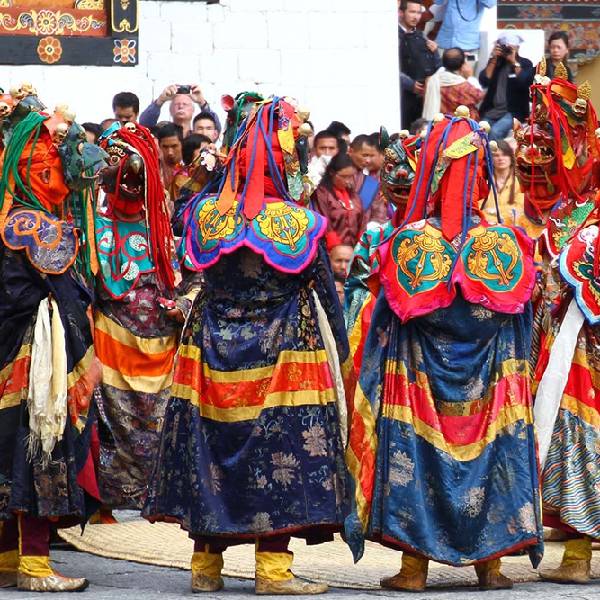
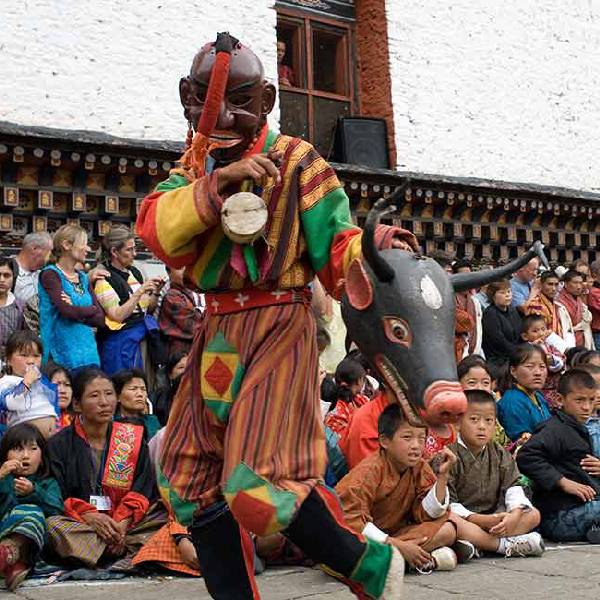
One distinctive element of Dolay Drupchen is the participation of monks from Nephu Monastery. Bhutan tourism documentation specifically records that monks from Nephu take part as masked-dance performers during the annual festival. These performances add a visible ceremonial dimension to an observance that otherwise centres strongly on prayer and tantric ritual.
Sacred masked dances, known as cham, should not be understood simply as cultural entertainment. Costumes, masks, musical rhythms, gestures, and ritual movement carry religious symbolism. Depending on the ceremony, performers may represent protective figures, enlightened beings, or characters associated with Buddhist teachings. For devotees, witnessing such dances can itself form part of participating in an auspicious religious occasion.
The soundscape of the observance is equally important. Deep horns, drums, cymbals, bells, chanting, and ritual recitations create a very different atmosphere from an ordinary visit to a monastery. The repetition is deliberate. Vajrayana ceremonies often depend on carefully maintained sequences, with monks performing their assigned roles as part of a larger religious practice continuing across many days.
Offerings are another essential part of the setting. Butter lamps, incense, ritual cakes, grains, water bowls, flowers, and other ceremonial objects may be arranged according to the specific practice being performed. These are not decorative additions. Each has a place within the ritual system and contributes to the atmosphere of concentration and devotion.
Local devotees may visit during the period to pray, make offerings, receive blessings, or spend time within the sacred environment. Unlike a major tourist-oriented event, however, Dolay Drupchen is not defined by enormous crowds or a continuous entertainment programme. Its appeal lies precisely in its more contemplative character.
For travelers, this provides an opportunity to encounter a side of Bhutanese Buddhism that is often less visible than the famous tshechus of Paro and Thimphu. A visitor may witness monks engaged in extended ceremonies rather than arriving only for a sequence of colourful dances. The experience can help explain why ritual practice remains such an important part of Bhutan’s living religious heritage.
The Paro setting also makes the occasion especially interesting. Forested slopes, traditional farmhouses, monasteries, prayer flags, and sacred sites surround the valley. Travelers already planning to visit Paro Taktsang can use the festival period to gain a broader understanding of the religious traditions connected with the area rather than viewing Tiger’s Nest only as an architectural landmark.
Respectful behaviour is essential. Visitors should avoid interrupting recitations, walking between monks and ritual objects, touching offerings, or entering restricted areas. Photography may be prohibited inside temples, and even when cameras are permitted, close photographs of monks during religious practice should only be taken when appropriate.
Festival programmes can also change according to monastic and lunar-calendar requirements. Travelers hoping to witness a particular masked dance or public ceremony should confirm the daily schedule locally rather than assuming every activity occurs throughout the entire festival period.
At its heart, Dolay Drupchen in Bhutan is a festival of sustained spiritual practice rather than spectacle. Prayer, mantra, meditation, ritual offerings, sacred dance, and monastic discipline come together over several days with the intention of overcoming obstacles and cultivating positive conditions. Set within the sacred landscape of Paro, the observance offers travelers a quieter and more contemplative window into Bhutan’s Vajrayana Buddhist traditions.